Session 4 - The Blue and Orange Card Metaphor
| Site: | Wintec Learning |
| Course: | Invitational Education (eLearning Example) |
| Book: | Session 4 - The Blue and Orange Card Metaphor |
| Printed by: | Guest user |
| Date: | Wednesday, 10 June 2026, 8:48 AM |
Description
Purkey saw that the '5 Ps' in people's lives either invite or disinvite them to engage in striving toward their human potential.
The activities in this section get you thinking about the various 'Ps' in your life and how they are either blue or orange - inviting or disinviting.
Activity 4.1 - Sunshine & Smog
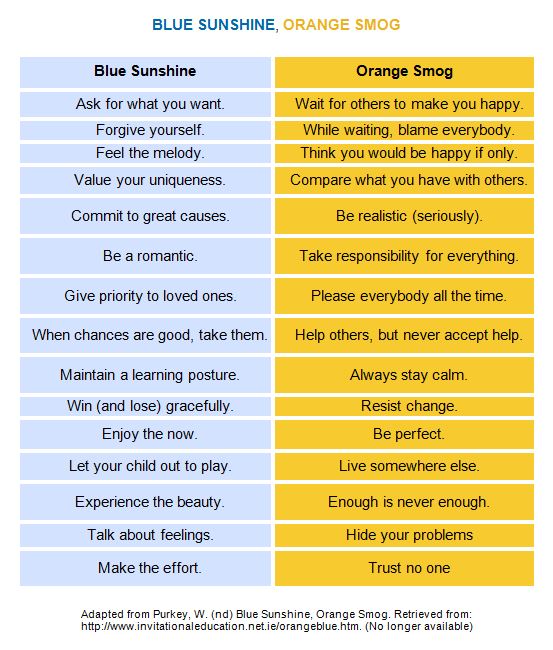
Purkey chooses blue as the inviting colour from the analogy of a blue sky, and orange as the disinviting colour from the analogy of an orange smog-filled sky.
- When a place, policy, programme, process or person evokes a positive feeling from a client, colleague or student that person is said to be ‘invited’ or given a blue card.
- When a place, policy, programme, process or person evokes a negative feeling from a client, colleague or student that person is said to be ‘disinvited’ or given an orange card.
 Click on the icon to read an article about the blue and orange cards metaphor. Then click here to see a graphical summary of the metaphor.
The activities in this session will get you thinking about what things in your students'/clients'/colleagues' lives are blue or orange cards.
The table below shows some examples of blue/orange card statements.
Activity 4.1.1 - Blue Inviting Cards
Referring back to the Starfish Analogy from the last session, think about what you know of the institution you work for.
Remember the 5 Ps are: Places, Policies, Programmes, Processes, People
 Click on the screen below to post one or two examples of the 5 Ps at your institution that evoke POSITIVE feelings from clients/colleagues/students.
If it isn't displaying properly below click on the icon above to go straight to the page on the internet.
Activity 4.1.2 - Orange Disinviting Cards
Referring back to the Starfish Analogy from the last session, think about what you know of the institution you work for.
Remember the 5 Ps are: Places, Policies, Programmes, Processes, People
 Click on the screen below to post one or two examples of the 5 Ps at your institution that evoke NEGATIVE feelings from clients/colleagues/students.
If it isn't displaying properly below click on the icon above to go straight to the page on the internet.
Activity 4.1.3 - Making disinviting inviting
There are many signs, instructions and statements all around us and the sad fact is many of them are disinviting. But, contrary to what many sign writers think (and what some of the innovative ones are realising), signs and statements do not have to be disinviting.
 Click on the icon to participate in an activity to help re-word some of the disinviting signs we experience in life today.
 Click the book icon to read about some other possible shades of cards. When orange cards can help and blue cards can be detrimental.
Just read to page 5.
 Record your answers to the following questions in your blog.
- There are always two sides to an inviting/disinviting message - giving and receiving. How does this fit with the Perceptual Tradition and Self-Concept Theory (think back to the foundations of Invitational Education)?
- Describe an experience where you've learned or been strengthened by seemingly Orange cards?
- Describe an experience where you've given what you thought was a Blue card but it was received as Orange?
Activity 4.2 - Assessment 1
 This activity leads directly into the first assignment. Read through the first assignment before you begin the activity and remember to make notes as you complete the activity.
 Click on the icon to download a PowerPoint file that contains an activity to help you think about the starfish model and the idea of inviting blue cards.
 After completing the activity, upload your finished PowerPoint (or a screenshot) to this discussion forum.
Once you have done so you will be able to see what others have done and you can discuss your results if you wish - especially if there are differences.
Activity 4.3 - Case Study
 Click on the icon to enter an activity where you will read and respond to a Case Study.
The case study contains the experiences of a fictitious person called Joe Jones, who was shown a series of 'Orange Cards'.
Once you've finished this activity you'll be ready to do the first review activity.
This is the end of Session 4. Click to do the Review Activity for Part A.