Session 8 - Managing Conflict using the 5 Cs
| Site: | Wintec Learning |
| Course: | Invitational Education (eLearning Example) |
| Book: | Session 8 - Managing Conflict using the 5 Cs |
| Printed by: | Guest user |
| Date: | Wednesday, 10 June 2026, 8:48 AM |
Description
Purkey also developed a set of steps to help teachers manage conflict while trying to keep as inviting as possible.
This session discusses these steps as well as a couple of other ideas.
Activity 8.1 - Problems with the Invitational model
|
When Yen Ho was about to take up his duties as tutor to the heir of Ling, Duke of Wei, he went to Ch’u Po Yu for advice. “I have to deal with a man of depraved and murderous disposition … How is one to deal with a man of this sort?” “I’m glad”, said Ch’u Po Yu, “that you asked this question… The first thing you must do is not to improve him, but to improve yourself.” Taoist Story of Ancient China Bennis and Naus, (1985) in Purkey, W. (1992) Conflict resolution: An invitational approach. Journal of Invitational Theory and Practice, 1(2). 111-116 |
 Read the quote above and, thinking about what you know of invitational theory, answer the following questions. Record your thoughts in your blog.
-
How does this story fit with this theory?
-
What are some of the issues that this story might highlight for the invitational model?
- What is you opinion of this quote from Purkey (1992)?
“One criticism of Invitational Theory (Purkey and Novak, 1984; Purkey and Schmidt, 1987; Purkey and Stanley, 1991) is that it does not address itself to difficult situations. It is easy to be inviting when things are going well, say critics, but in times of conflict it’s time to get tough: to forget inviting and start demanding. This article refutes the criticisms by first reviewing the basic assumptions of Invitational Theory and then explaining how the theory can be used to handle conflicts, both minor and major, that occur in one’s personal and professional life.”
 Read the following question and respond by posting to the padlet.
If it doesn't display properly, click on the icon to see it outside of Moodle.
How do you think Invitational Theory might address the problem of conflict and difficult situations?
- Brainstorm some of your ideas using the Padlet below. If you like you can brainstorm questions you have about how this could happen, or the problems you think there are with the theory.
Activity 8.2 - Assumptions (Again)
 Think (or click) back to Activity 1.3 way back at the beginning of this module. Do you remember the four basic assumptions?
- Tr_________
- Re________
- Op________
- In_________
 Now click on the icon to download the reading for this section (JITP Vol1 Issue2).
(You will refer to this reading in Activity 8.3 as well)
 Read the 'Basic Assumptions of Invitational Theory' section of the reading (page 111-112) and record your answer to the following questions in your blog.
- How do these assumptions create a foundation for dealing positively with situations of conflict?
- How could invitational theory be applied to situations involving conflict?
Activity 8.3 - The Rule of the 5 Cs
 Read the rest of the reading from Activity 8.2 (i.e. pages 113-116)
 Click the icon to download a PowerPoint file that will help you complete the 5 Cs short task.
Activity 8.4 - Conflict Scenarios
 Think about the following scenarios.
How would you feel in this situation? What do you think you would do?
Each of these scenarios involves a potential conflict.
- A colleague was working on a project. They asked you for your help. You were happy to help, and volunteered your ideas and several hours of your own time. You feel that your input is clearly evident in the final project. However, your colleague has not given you any acknowledgment or credit for the work you did.
- You are suspicious about an assignment that one of your students has given you. You are told by another student that the first student paid someone to write their assignment for them.
- A student has handed in a late assignment, however they did not ask for an extension. The rules in the department clearly state that an extension must be gained prior to the deadline. The student expects you to mark their assignment without penalty.
 Answer the following questions in your blog.
Refer to the article in Activity 8.2 to help you.
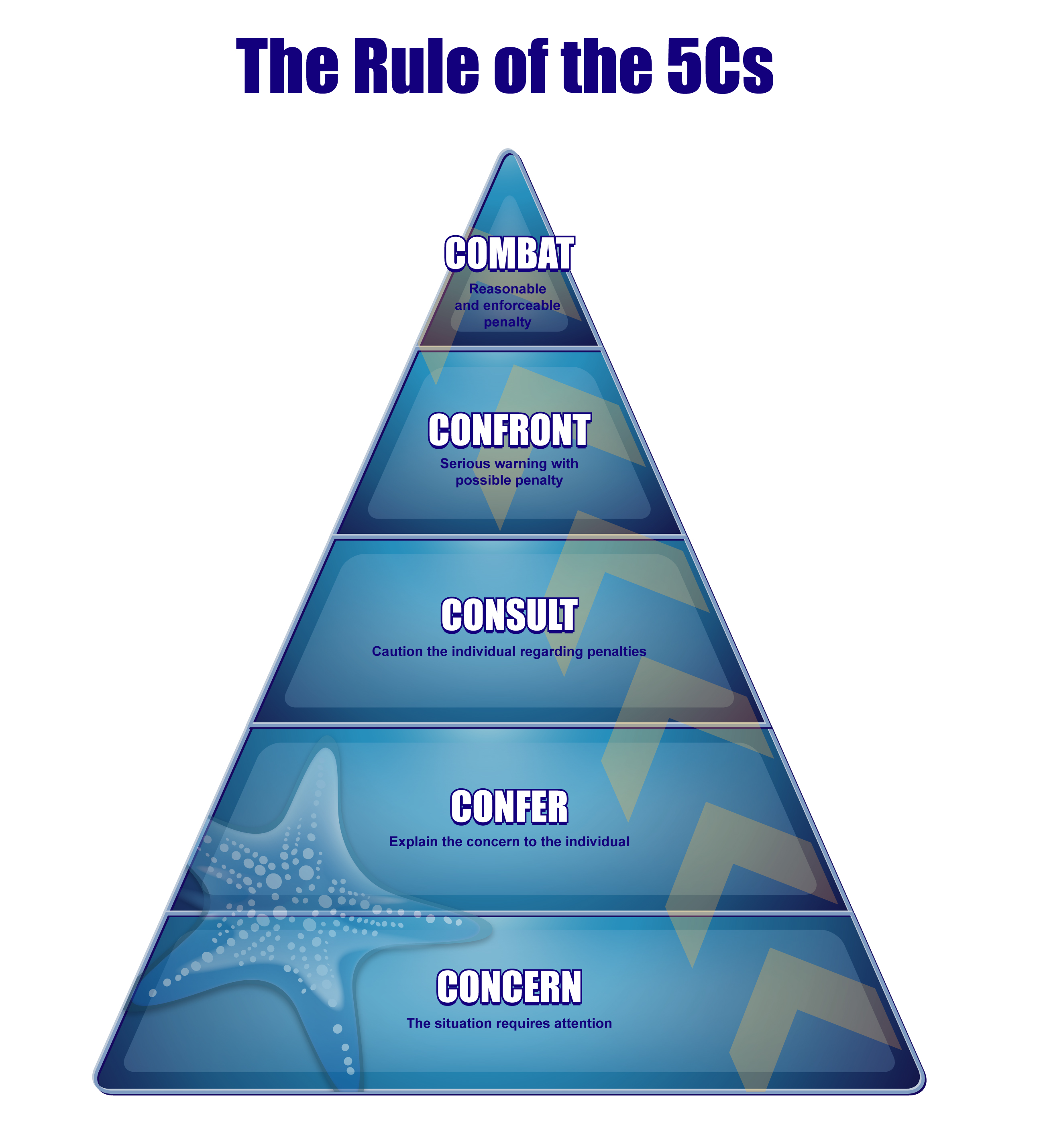
- Beginning at the base of the conflict resolution triangle, think about how each conflict scenario might be handled. How could you potentially resolve this conflict at the lowest possible level? I.e. begin with 'Concern' and ask the eight questions about the situation. Then move onto 'Confer'.
- How would the situation be handled at each level of the triangle?
 Click on the icon to share your responses to ONE of the scenarios.
Activity 8.5 - Assignment Two Preparation
 Read through the Assignment Two guidelines.
Check that you understand the requirements. Please post to the 'Assignment Discussion Forum' or contact the tutor if you have any questions or concerns.
 Complete the following tasks in your blog.
- Brainstorm situations that have involved conflict in your professional life. Choose a situation that will work best for the assignment, and that you feel comfortable writing about.
- Re-read the 5Cs article. As you read each section make notes on how your situation relates to each level of the conflict triangle. This is provided below if you wish to make notes around it.
- Read through the notes you have made. Ask yourself what actions would it be appropriate to take at each level? Make a list of possible actions for each level of the conflict.
- You may email the tutor with some examples from your conflict situation if you would like to check that you have understood the requirements of the assignment.
You should now be ready to complete at least Part C of Assignment Two. 
Read through the assignment and please ask if you have any questions.
This is the end of the last Session. Click to do the Review C Activity in preparation for the final assignments.